


 >
>


Tight Tolerance CNC Machining Explained: Precision Standards, Key Factors, and Applications
By hqt
Aug 31, 2026
Related Posts

Low Volume CNC Machining Guide
2026-09-21<

How to Improve Precision Cutting Efficiency: A Full-Link Solution for Process Optimization and Intelligent Manufacturing
2026-09-18<

CNC Prototype Machining Guide: Turning Concepts into Precision Parts
2026-09-15<

How CNC Achieves Micron Accuracy
2026-09-08<
Tight tolerance machining refers to manufacturing parts with extremely narrow dimensional boundaries, typically within variations of ±0.0005 inches (0.0127 mm) or smaller. In high-stakes manufacturing sectors where minor deviations cause assembly failure or mechanical breakdown, tight tolerance machining ensures critical components function reliably under severe operational conditions. Understanding how advanced CNC machining achieves these exacting standards helps engineering teams and procurement professionals make informed manufacturing decisions.
Understanding Tolerances in Precision CNC Machining
In manufacturing, tolerance defines the total allowable variation in a part's physical dimensions. Standard CNC machining routinely holds tolerances around ±0.005 inches. Tight tolerance machining pushes these boundaries into micron-level precision, requiring strict adherence to Geometric Dimensioning and Tolerancing (GD&T) principles.
Beyond linear dimensions, tight tolerance machining controls geometric characteristics, including:
- Concentricity and Coaxiality: Ensuring cylindrical features align along a shared central axis.
- Flatness and Parallelism: Maintaining uniform planar surfaces across the entire part length.
- Runout and Perpendicularity: Minimizing rotational wobble and maintaining precise 90-degree feature intersections.
Critical Factors for Achieving Tight Tolerance Machining
Consistently delivering tight tolerance machining demands a fully controlled production environment. Machine shops manage several interconnected technical variables to maintain accuracy across production runs:
Machine Tool Rigidity and Thermal Stability
High-precision CNC machines require rigid cast-iron or mineral-composite bases to absorb cutting vibrations. Thermal expansion presents another continuous challenge. Ambient temperature shifts alter machine structures and workpieces alike. Specialized facilities operate in climate-controlled rooms and use thermal compensation algorithms within the CNC controller to offset dynamic heat expansion.
Advanced Tooling and Wear Management
Cutting tools deflect under mechanical load and wear down during operation. Tight tolerance machining relies on premium carbide, ceramic, or diamond-coated cutting tools paired with high-precision hydraulic or shrink-fit tool holders. Automated tool-setting probes constantly measure tool wear, updating offsets dynamically to prevent dimensional drift.
Material Selection and Workpiece Behavior
Metals and plastics respond differently to cutting forces and heat. Materials such as titanium, Inconel, and hardened stainless steel generate high cutting temperatures, leading to stress distortion if unmanaged. Machinists select tailored cutting speeds, feed rates, and high-pressure coolant delivery systems to stabilize material temperatures during cutting.
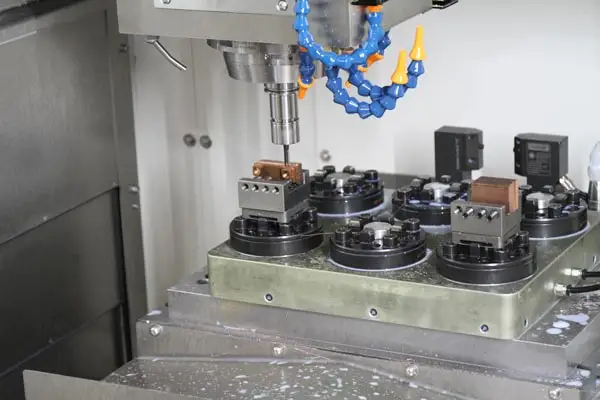
Workholding and Stress Relief
Excessive clamping force deforms workpieces during machining, causing dimensions to shift once the part is released from the fixture. Custom workholding solutions, such as vacuum chucks, soft jaws, and dedicated modular fixtures, distribute holding force evenly without introducing mechanical stress.
In-Process Metrology and Inspection
Quality control operates parallel to the machining process. Manufacturers deploy high-accuracy Coordinate Measuring Machines (CMM), optical comparators, laser micrometers, and surface profilometers to verify part geometry before, during, and after final operations.
Key Industry Applications
Industries where component failure carries extreme risk depend on tight tolerance machining for operational safety and performance:
- Aerospace and Defense: Engine components, turbine blades, fuel system valves, and landing gear mechanisms require tight tolerances to endure high pressure and extreme thermal cycling.
- Medical Device Manufacturing: Surgical instruments, orthopedic implants, and diagnostic equipment require exact tolerances for safe human integration and precise mechanical articulation.
- Semiconductor Equipment: Wafer handling stages, vacuum chamber manifolds, and optical alignment mounts depend on sub-micron accuracy to maintain cleanroom performance.
- Automotive and Power Generation: Fuel injectors, turbocharger cartridges, and electric vehicle powertrain components require exact fits to maximize energy efficiency and reduce friction.
Optimizing Designs for Tight Tolerance Machining
Specifying tight tolerances across an entire part unnecessarily raises production costs and extends cycle times. Engineering teams can optimize component designs through strategic planning:
- Isolate Critical Features: Apply tight tolerances exclusively to mating surfaces, bearing fits, and sealing grooves, keeping non-critical geometries at standard tolerances.
- Conduct Early DFM Reviews: Collaborate with manufacturing partners during early design stages to identify potential tool access issues, chatter risks, or workholding constraints.
- Account for Post-Processing: Surface treatments like anodizing, plating, or heat treating alter final dimensions. Calculate coating thicknesses upfront so premachined dimensions fall within acceptable tolerance bands after finishing.
Frequently Asked Questions
What is the difference between standard machining and tight tolerance machining? Standard machining typically holds dimensional variations between ±0.001 and ±0.005 inches. Tight tolerance machining targets boundaries of ±0.0005 inches or smaller, requiring high-end CNC machinery, specialized tooling, environmental climate control, and advanced metrology equipment.
Which materials work best for tight tolerance machining? Dimensionally stable materials like aluminum 6061/7075, stainless steel 316L, brass, titanium, and engineering plastics such as PEEK perform well. Highly ductile or soft materials require specialized tooling geometries to prevent burring and thermal warping.
How does thermal expansion impact tight tolerance machining? Temperature fluctuations expand or contract metal workpieces and cutting tools. A shift of just a few degrees can cause dimensions to drift out of specification. Precision shops mitigate this using climate-controlled environments and high-pressure coolant systems.
Why does tight tolerance machining cost more than standard machining? Achieving micron-level accuracy requires slower feed rates, high-grade cutting tools, frequent CMM inspections, specialized workholding, and experienced CNC programmers, all of which increase overall processing time and machine wear.


Request A Quote
We offer one-stop consulting services from design to mass production, ready to answer your questions anytime!


