


 >
>


EDM vs CNC: A Comprehensive Comparison for Precision Manufacturing Decision-Making
By hqt
Aug 27, 2026
Related Posts

Low Volume CNC Machining Guide
2026-09-21<

How to Improve Precision Cutting Efficiency: A Full-Link Solution for Process Optimization and Intelligent Manufacturing
2026-09-18<

CNC Prototype Machining Guide: Turning Concepts into Precision Parts
2026-09-15<

How CNC Achieves Micron Accuracy
2026-09-08<
Introduction
In the competitive landscape of modern precision manufacturing, selecting the right machining process directly impacts product quality, production timeline, and overall cost efficiency. Two dominant technologies—Electrical Discharge Machining (EDM) and Computer Numerical Control (CNC) machining—stand as cornerstones of the industry, each with distinct capabilities and optimal use cases. Understanding the fundamental differences between EDM and CNC machining empowers engineers, project managers, and business leaders to make informed decisions that align with their specific manufacturing objectives. This analysis examines the core principles, comparative advantages, and practical applications of both processes to guide strategic manufacturing strategy.
Understanding EDM: The Non-Contact Precision Process
Electrical Discharge Machining, commonly referred to as EDM or spark machining, is a non-traditional subtractive manufacturing process that removes material through controlled electrical discharges between a tool electrode and a workpiece. The process operates by generating rapid, repetitive spark discharges in a dielectric fluid, producing instantaneous temperatures ranging from 8,000 to 12,000 degrees Celsius, which melt and vaporize the workpiece material without physical contact.
The two primary EDM configurations are wire EDM and sinker EDM. Wire EDM employs a continuously traveling thin metal wire—typically brass or copper—to cut two-dimensional profiles through conductive materials, achieving dimensional tolerances as tight as ±0.002 mm. Sinker EDM, also known as ram EDM, uses a custom-shaped graphite or copper electrode to reproduce complex three-dimensional cavities and recessed features that would be difficult or impossible to achieve with conventional cutting tools.
EDM's defining characteristic is its ability to machine materials regardless of their hardness, as material removal relies on thermal erosion rather than mechanical force. This makes it uniquely suited for hardened tool steel, carbide, titanium, and other high-strength conductive materials that pose significant challenges for traditional cutting processes.
Understanding CNC Machining: The Mechanical Cutting Standard
Computer Numerical Control machining represents the automated control of machining tools through pre-programmed computer software that dictates the movement of factory tools and machinery. CNC machining encompasses a broad range of processes including milling, turning, drilling, and boring, all of which remove material through physical contact between rotating cutting tools and the workpiece.
CNC machining systems operate using G-code instructions generated from CAD/CAM software, enabling precise, repeatable control over tool paths and workpiece positioning across multiple axes. Modern CNC mills can operate on three, four, or five axes, enabling the production of highly complex three-dimensional geometries with exceptional accuracy and consistency. The process works effectively on a wide spectrum of materials, including metals, plastics, wood, foam, and composites.
The primary advantages of CNC machining include high material removal rates, excellent surface finish quality, and the ability to handle large production volumes efficiently. With proper tooling and fixturing, CNC machines can operate continuously with minimal operator intervention, making it the workhorse of modern manufacturing facilities worldwide.
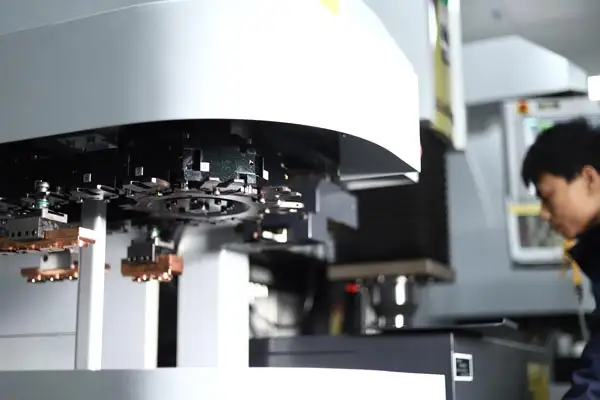
Core Differences Between EDM and CNC Machining
Material Removal Mechanism
The most fundamental distinction between EDM and CNC machining lies in how material is removed. CNC machining operates on mechanical cutting action—the cutting tools physically shear material from the workpiece through shearing action. This mechanical approach imposes inherent limitations: the cutting tool must be harder than the workpiece material, and cutting forces can cause deflection or damage delicate features. EDM, by contrast, removes material through thermal erosion, eliminating mechanical contact between the electrode and the workpiece. This non-contact nature means that EDM is unaffected by material hardness and introduces no cutting forces, enabling the machining of fragile or thin-walled structures without distortion.
Material Compatibility
CNC machining offers broad material compatibility, processing virtually all machinable materials including aluminum, steel, stainless steel, brass, copper, titanium, plastics, and composites. The only practical limitation is material hardness; as workpiece hardness approaches the hardness of available cutting tools, tool wear accelerates dramatically and surface quality degrades.
EDM is constrained to electrically conductive materials only. Non-conductive materials such as most ceramics, plastics, and composites cannot be processed through conventional EDM. However, within conductive materials, EDM exhibits remarkable versatility. It machines hardened tool steels, carbides, and high-temperature superalloys with equal ease, regardless of hardness level—a capability that sets it apart from all mechanical machining alternatives.
Precision and Tolerance Capabilities
Both EDM and CNC machining achieve high precision, but they excel in different dimensions of precision. Wire EDM consistently achieves tighter tolerances, particularly for internal features and complex two-dimensional profiles, with typical precision ranging from ±0.002 mm to ±0.005 mm. The absence of cutting forces means zero tool deflection, enabling consistent results even for fine features.
CNC machining delivers excellent precision as well, typically ranging from ±0.005 mm to ±0.025 mm for well-setup machines. While five-axis CNC machining centers excel at machining complex surfaces precisely, they cannot match EDM for sharp internal corners and ultra-fine features.
Speed and Productivity
When it comes to material removal rate, CNC machining holds a decisive advantage. For typical materials, CNC milling can remove material at rates orders of magnitude faster than EDM, particularly in roughing operations. A CNC mill can remove a cubic centimeter of aluminum in minutes, whereas EDM would require hours to achieve the same volume removal.
EDM is inherently slower due to the nature of material removal—each spark removes only microscopic quantities of material. This makes EDM economically viable for finishing operations, complex features, and hardened materials where CNC cannot operate efficiently, but less suitable for high-volume material removal.
Surface Finish Quality
CNC machining generally produces superior surface finishes directly from the machine, particularly with high-quality finishing tools and optimized parameters. CNC-machined surfaces typically exhibit uniform texture characteristic of tool marks but are generally free from the recast layers associated with thermal processes. Surface roughness values in CNC finishing can reach Ra 0.4 μm or better with appropriate tooling and feeds.
EDM surfaces display a characteristic matte, cratered texture resulting from the successive spark erosion process. While modern multi-pass EDM strategies can achieve surface finishes as smooth as Ra 0.2 μm, the process inherently creates a recast layer—also known as a white layer—typically ranging from 2 to 20 micrometers in thickness. This recast layer can contain microcracks and may require post-processing such as grinding or polishing for applications requiring high fatigue resistance.
Cost Structure Analysis
The cost comparison between EDM and CNC machining differs significantly in structure. CNC machining typically has lower hourly machine rates, making it cost-effective for most applications. The primary cost drivers in CNC machining include machine time, tooling costs, and setup labor. For high-volume production runs, CNC machining generally provides economies of scale that dramatically reduce per-unit costs.
EDM typically carries higher effective hourly rates due to slower material removal rates, electrode manufacturing costs, and specialized equipment. Sinker EDM requires custom electrode fabrication—typically from graphite or copper—adding both cost and lead time. Wire EDM avoids custom electrode costs since the wire itself is relatively inexpensive, making it more cost-competitive for certain geometries.
When to Choose EDM Over CNC Machining
EDM is the preferred choice in several distinct manufacturing scenarios. First, when working with extremely hard materials such as hardened tool steel, carbide, or high-temperature alloys where conventional cutting tools struggle with excessive wear or cannot achieve acceptable surface quality. Tool and die manufacturing, particularly for injection molds and stamping dies, relies heavily on EDM for cavity machining after hardening.
Second, EDM excels at producing sharp internal corners and square-bottomed cavities that are physically impossible with rotating cutting tools, which always leave a radius equal to the tool radius. For parts requiring true sharp inside corners with radii as small as 0.02 mm, EDM is the only viable option.
Third, micro-features and extremely small, delicate structures benefit from EDM's non-contact nature. Features such as micro-holes, narrow slots, and thin-walled structures that would deflect or break under the cutting forces of CNC machining can be reliably produced with EDM. Medical devices, fuel injection components, and micro-mechanical parts frequently employ EDM for these challenging features.
When to Choose CNC Machining Over EDM
CNC machining is the superior choice for most general machining scenarios. For projects involving large amounts of material removal, CNC machining delivers dramatically faster cycle times and lower per-unit costs. High-volume production runs particularly benefit from CNC's high material removal rates and ability to operate with minimal per-part cycle times.
CNC machining is also the clear choice when working with non-conductive materials such as plastics, wood, foam, and non-conductive ceramics—materials that EDM simply cannot process. The broader material compatibility makes CNC indispensable in industries ranging from aerospace to consumer products where diverse materials are used.
For complex three-dimensional sculpted surfaces and freeform geometries, particularly with five-axis capability, CNC machining provides efficient production compared to sinker EDM, which would require multiple custom electrodes and extensive setup time. Modern five-axis CNC centers produce complex geometries in a single setup, reducing overall production time.
Additionally, when superior surface finish without secondary operations is a requirement, CNC machining typically produces better as-machined surface quality without the recast layer inherent in EDM. For fatigue-critical components where surface integrity is paramount, CNC machining often eliminates the need for post-processing steps.
Synergistic Integration: Combining EDM and CNC
In practice, EDM and CNC machining are not competing technologies but complementary processes. The most efficient manufacturing strategies often combine both processes to leverage their respective strengths.
A common hybrid approach involves CNC roughing followed by EDM finishing. For example, in mold manufacturing, a CNC mill rapidly removes the bulk of material from a mold block, leaving carefully calculated stock allowance. The part is then heat-treated to achieve the required hardness. After hardening, EDM is used to finish the cavity geometry to the final dimensions, taking advantage of EDM's ability to machine hardened material while achieving sharp internal corners and fine details.
Another effective combination is CNC machining for external features and EDM for internal features that CNC cannot effectively access. CNC mills produce the overall part geometry efficiently, while wire EDM cuts precision internal profiles and features such as keyways, splines, and intricate cut-outs.
This synergistic approach optimizes both time and cost, reduces overall production time while maintaining the highest quality standards.
Frequently Asked Questions
Is EDM more accurate than CNC machining?
EDM, particularly wire EDM, can achieve tighter dimensional tolerances—typically ±0.002 mm to ±0.005 mm compared to ±0.005 mm to ±0.025 mm for CNC. However, the comparison depends on the specific feature type and machine quality. CNC can be equally precise for certain features, while EDM excels at internal corners and hard materials where tool deflection is not a factor.
Can EDM replace CNC machining entirely?
No, EDM cannot replace CNC machining. EDM is limited to conductive materials only and has significantly slower material removal rates. CNC machining handles a broader range of materials and is dramatically faster and more cost-effective for most general machining applications. The two processes are complementary rather than competitive.
What is the typical cost difference between EDM and CNC machining?
EDM generally costs 3 to 5 times more than CNC machining for equivalent material removal due to slower speeds and electrode costs. However, for features that CNC cannot produce at all—such as sharp internal corners in hardened steel—EDM provides unique value that cannot be directly compared on a pure cost-per-volume basis.
Which process should I choose for prototype development?
For most prototyping with standard geometries and standard materials, CNC machining is generally faster and more cost-effective. EDM is better suited for prototypes requiring hard materials, sharp internal corners, or micro-features where CNC cannot meet the design requirements.
How does surface finish compare between EDM and CNC?
CNC machining typically produces better as-machined surface finishes with characteristic tool marks and generally no recast layer. EDM produces a cratered surface texture and leaves a recast layer of 2–20 μm. With multi-pass finishing, EDM can achieve Ra 0.2 μm smoothness, but post-processing may be needed for fatigue-critical applications to remove the recast layer.
Share on Social:


Request A Quote
We offer one-stop consulting services from design to mass production, ready to answer your questions anytime!


