


 >


OEM Precision Parts Manufacturing: A Complete Guide for Global Buyers
By hqt
Sep 28, 2026
Related Posts

Stainless Steel Precision Parts: A Complete Guide to Stainless Steel Machining
2026-11-02<

What to Pay Attention to When Machining Tungsten Carbide
2026-10-30<

Stainless Steel Precision Parts: A Complete Guide for Modern Manufacturing
2026-10-27<

When Is a Hot Runner System Essential for Plastic Mold Manufacturing?
2026-10-22<
Every reliable machine starts with parts that fit. OEM precision parts manufacturing is the discipline of producing components exactly to a customer's specification, where the buyer owns the design and the manufacturing partner owns the process, the tooling, and the quality record. For procurement and engineering teams, choosing the right partner is no longer about finding the lowest quote. It is about finding a supplier that can hold tight tolerances at volume, document every dimension, and deliver on schedule.
This guide explains what OEM precision parts manufacturing involves, what capabilities separate a competent supplier from a risky one, and how to evaluate partners in 2026.
What Is OEM Precision Parts Manufacturing?
OEM precision parts manufacturing refers to the production of custom components made to a buyer's own drawings, specifications, and material requirements. The manufacturer does not sell a standard catalogue item; it builds to print, holding dimensional tolerances that are tight enough for the part to assemble and function correctly.
The distinction from ODM matters. In OEM manufacturing, the customer defines the product, the intellectual property, and the acceptance criteria. In ODM, the supplier contributes the design. Buyers who already have a full product definition should look for a partner with genuine OEM engineering capability, not a supplier that only repackages standard designs.
A capable OEM partner typically covers the full chain: design-for-manufacturing (DFM) review, tooling, CNC precision machining, heat treatment and finishing, inspection, and packaging.
Core Capabilities That Define a Serious Supplier
Multi-axis CNC machining and process breadth
The equipment list tells you what a supplier can realistically produce. Three-axis machining centres handle most simple prismatic work at economical precision, typically IT8–IT9. Five-axis machining centres machine complex contours, angled features, and thin-wall structures in a single setup, which removes the cumulative error introduced by repeated clamping. That is why five-axis work is standard for robot joints, medical housings, and semiconductor components.
Turning-milling compound machines suit shafts, valves, and bushings, while EDM, wire cutting, and precision grinding finish features that milling cannot reach.
Tolerance control: the real dividing line
Tolerance is where OEM precision parts projects succeed or fail. General tolerances usually follow ISO 2768 or GB/T 1804. In practice:
- General precision: ±0.05 mm, sufficient for most industrial components.
- High precision: IT6–IT7, roughly 0.003–0.015 mm, achieved with five-axis equipment and coordinate measuring verification.
- Ultra-precision batches: 0.003–0.005 mm held consistently across a production run, which requires thermal compensation, tool-wear monitoring, and statistical process control.
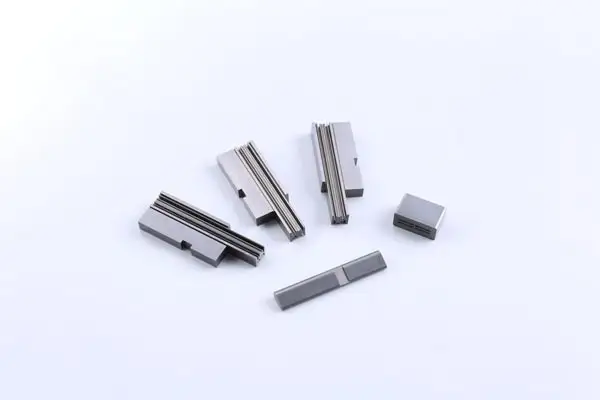
One economic fact is worth remembering: tightening a tolerance from 0.01 mm to 0.005 mm can raise machining cost by 30% to 50%. Experienced engineers therefore apply tight tolerances only to critical mating dimensions and relax them everywhere else. A supplier that pushes back on over-specified drawings is usually protecting your budget, not avoiding work.
Material selection
Material choice follows function. Common selections include:
- 6061 and 7075 aluminium: lightweight structural parts, housings, and chassis components; compatible with anodising.
- 304 and 316 stainless steel: corrosion resistance for wet, chemical, or hygienic environments.
- 40Cr and tool steels: gears, valve cores, and load-bearing bases, often QPQ nitrided for wear resistance.
- Copper alloys: conductive bushings and low-friction micro components.
- Engineering plastics such as PEEK, PVDF, and PTFE: semiconductor and chemical-contact applications.
Surface finishing
Finishing determines service life as much as appearance. Options include hard anodising and QPQ salt-bath nitriding for wear resistance, passivation and black oxide for basic corrosion protection, and mirror polishing for sealing and sliding surfaces. A good partner applies finishing in a way that preserves the underlying micron-level geometry.
Quality Assurance: The Backbone of Every Order
A supplier's quality system, not its sales presentation, protects your production line. Look for a four-stage inspection chain covering incoming material (IQC), in-process checks (PQC), final inspection (FQC), and pre-shipment verification (OQC).
Verification equipment matters as much as the inspection stages. Coordinate measuring machines, optical comparators, and surface roughness testers should be capable of resolving the tolerances you specify. For high-precision work, process capability (CPK) is typically held at 1.33 or above, and every batch should ship with a dimensional report and traceable records.
Certification confirms the system behind the numbers. ISO 9001 is the baseline, IATF 16949 applies to automotive work, ISO 13485 to medical devices, and AS9100 to aerospace. Buyers in regulated industries should treat these as entry requirements rather than differentiators.
Industries That Depend on OEM Precision Parts
- Automotive and EV: motor mounts, transmission components, lightweight structural parts.
- Medical devices: surgical instrument components and diagnostic equipment housings, often under cleanroom conditions.
- Semiconductor equipment: chambers, fixtures, and fluid-handling parts requiring sub-5-micron stability.
- Robotics and automation: joints, reducers, and thin-wall frames.
- New energy: battery, charging, and photovoltaic equipment components.
- Consumer electronics and communications: precision housings, connectors, and optical parts.
How to Evaluate an OEM Precision Parts Supplier
Use these checks before committing to a volume order:
- Engineering capability. Ask whether the supplier produces a DFM report and flags manufacturability risks before quoting. This is the clearest signal of a real engineering team.
- Equipment and precision margin. Confirm the machine mix and the inspection equipment. A supplier should routinely hold roughly one-third of the specified tolerance as internal margin.
- Certifications and audit history. Verify the certificates are current and cover the processes you need.
- Traceability. Material certificates, inspection records, and process data should be retrievable by batch.
- Tooling and IP ownership. Put mould and fixture ownership in writing. Require written approval for any material or process change.
- Batch flexibility. A good partner supports prototype quantities through to volume production without a change of factory.
- Quote transparency. Material, machining, finishing, and inspection costs should be itemised, with tiered pricing for larger batches.
Trends Shaping the Industry in 2026
Digital process control is moving from optional to expected. MES-based tracking allows buyers to see production status and pull quality data on demand.
Flexible, small-batch production is growing as product cycles shorten. Suppliers that support rapid changeover win development-stage work and usually retain it through mass production.
Design and manufacturing integration has become a competitive requirement. Buyers increasingly want a partner that can contribute to structure optimisation and process feasibility, not just execute a drawing.
Sustainability is entering supplier scorecards. Material efficiency, energy management, and recyclable design are now part of many sourcing decisions.
FAQ
What are OEM precision parts?
OEM precision parts are custom components manufactured to a buyer's own drawings and specifications, with tight dimensional tolerances and documented quality records. The buyer retains the design and intellectual property; the manufacturer provides the process, tooling, and inspection.
What tolerance can OEM precision parts manufacturing achieve?
General precision is typically ±0.05 mm. High-precision CNC machining reaches IT6–IT7, or approximately 0.003–0.015 mm. With five-axis equipment, thermal compensation, and coordinate measuring verification, stable batch accuracy of 0.003–0.005 mm is achievable.
Which materials are most commonly used?
Aluminium alloys such as 6061 and 7075, stainless steels such as 304 and 316, alloy and tool steels, copper alloys, titanium, and engineering plastics including PEEK and PTFE. Selection depends on strength, weight, corrosion resistance, and thermal requirements.
Which certifications should a supplier hold?
ISO 9001 applies universally. Automotive work requires IATF 16949, medical devices require ISO 13485, and aerospace requires AS9100. Certification should be paired with a documented four-stage inspection process.
Is there a minimum order quantity?
Many capable suppliers accept small prototype runs and scale to volume production. MOQ depends on the process and tooling involved; custom tooling usually sets the practical floor.
How long does a typical order take?
Prototypes and simple parts can be delivered within days, while complex components with dedicated tooling typically require two to six weeks. Lead time should be confirmed against your production schedule rather than assumed.
How is intellectual property protected?
Through a signed NDA, written tooling ownership, controlled document handling, and a contract clause requiring written approval for any material or process change.


Request A Quote
We offer one-stop consulting services from design to mass production, ready to answer your questions anytime!


In This Article
Related Posts
Stainless Steel Precision Parts: A Complete Guide to Stainless Steel Machining
2026-11-02
What to Pay Attention to When Machining Tungsten Carbide
2026-10-30
Stainless Steel Precision Parts: A Complete Guide for Modern Manufacturing
2026-10-27
When Is a Hot Runner System Essential for Plastic Mold Manufacturing?
2026-10-22


