


 >


Multi-Cavity Injection Mold Characteristics
By hqt
Oct 09, 2026
Related Posts

Stainless Steel Precision Parts: A Complete Guide to Stainless Steel Machining
2026-11-02<

What to Pay Attention to When Machining Tungsten Carbide
2026-10-30<

Stainless Steel Precision Parts: A Complete Guide for Modern Manufacturing
2026-10-27<

When Is a Hot Runner System Essential for Plastic Mold Manufacturing?
2026-10-22<
Multi-cavity injection mold has long been the workhorse of high-volume production. Whether it is bottle caps and daily consumer goods, 3C electronic connectors, or precision medical device components, multi-cavity molds play the pivotal role of "producing multiple parts in a single cycle." Understanding the characteristics of multi-cavity injection molds is not only fundamental knowledge for mold design engineers, but also a prerequisite for manufacturing enterprises to make sound decisions in project approval, procurement, and capacity planning. This article systematically breaks down the core characteristics of multi-cavity injection molds from multiple dimensions, including efficiency, cost, quality, design, and maintenance.
I. What Is a Multi-Cavity Injection Mold
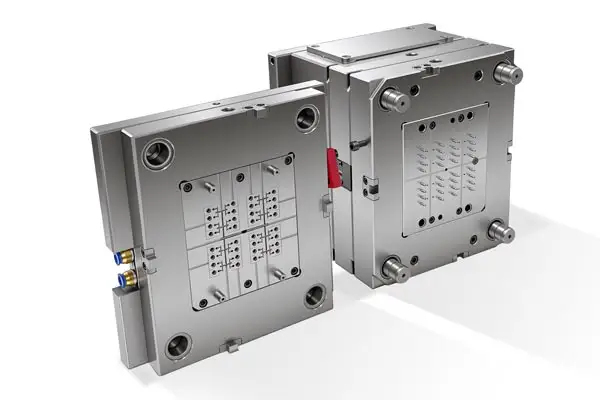
A multi-cavity injection mold is an injection mold equipped with two or more identical cavities in a single tool. It can mold multiple identical parts in a single injection cycle, in stark contrast to a single-cavity mold, which produces one part per cycle. Multi-cavity molds are used across an extremely wide range of applications, from common 2-cavity, 4-cavity, and 8-cavity configurations to 32-cavity, 64-cavity, and even higher cavity counts for high-volume products such as medical consumables and bottle caps.
The core value of a multi-cavity mold does not lie simply in "packing more cavities" into one mold base, but in ensuring that every cavity stably produces parts of consistent quality under the same set of process parameters. This is a systems engineering challenge that demands meticulous design and rigorous manufacturing.
II. Core Characteristics of Multi-Cavity Injection Molds
1. Significantly Higher Production Efficiency
The most intuitive advantage of a multi-cavity mold is its throughput capacity. Given a largely unchanged injection cycle, the number of cavities directly determines the output per shot, and mold output increases nearly linearly with cavity count. Taking an 8-cavity mold as an example, its output per cycle is eight times that of a single-cavity mold, while the cycle time typically increases by only about 10%, resulting in a several-fold increase in actual throughput. For high-volume, long-lead-time orders, multi-cavity molds can meet capacity requirements in a much shorter time without requiring multiple machines and multiple molds to run in parallel.
2. Dramatically Reduced Per-Unit Manufacturing Cost
Cost advantage is the most compelling economic driver of multi-cavity molds. The fixed costs of injection molding production, including machine depreciation, labor, energy consumption, and plant management overhead, are diluted as output per cycle increases. Industry practice shows that, provided the production volume is sufficiently large, a 16-cavity mold can reduce per-unit cost by approximately 60% to 80% compared with a single-cavity mold. Even accounting for the slight extension of cycle time due to cooling requirements, the unit-cost competitiveness of the multi-cavity approach in large-scale production remains outstanding.
It must be emphasized that this cost advantage has a clear precondition: only when the production volume is large enough and the mold cost can be fully amortized across output does the multi-cavity approach become economically viable. When volume is too small, the high upfront investment in a multi-cavity mold can instead become a burden.
3. Product Consistency Is Highly Dependent on Runner Balancing
The greatest technical challenge of multi-cavity molds lies in ensuring filling consistency across all cavities. When molten plastic is distributed from the sprue into each cavity, if the runner system is not properly balanced, each cavity may complete filling at different times, pressures, and temperatures, directly causing defects such as short shots, flash, warpage, or dimensional variation between parts.
The industry typically adopts two balancing strategies. The first is natural balancing, which uses geometrically symmetric runner layouts so that every cavity has an identical flow distance from the sprue; this is recognized as the gold-standard approach. The second is artificial balancing, which compensates for flow differences by adjusting runner cross-section dimensions or adopting valve-gated hot runner systems when a symmetric layout is not achievable. In addition, mold flow analysis software (such as Moldflow) is now the standard practice in multi-cavity mold design, using filling simulation and runner optimization to control the filling-time imbalance across cavities to within 5%.
4. Extremely High Demands on Design and Machining Precision
The precision requirements of multi-cavity molds far exceed those of single-cavity molds. The dimensional tolerances, surface quality, and surface roughness of all cavities must be highly consistent; any machining deviation in a single cavity will cause inter-cavity variation within the same batch of products. This requires high-precision machining equipment and strict tolerance control in the mold manufacturing stage, and in necessary cases, each cavity must be independently inspected and corrected. The cavity layout must also remain symmetric with reasonable spacing between adjacent cavities, ensuring the overall structural strength of the mold while avoiding thermal deformation interference between neighboring cavities.
5. Significantly Greater Difficulty in Cooling System Design
The cooling system directly determines the injection cycle time and the warpage tendency of the product. In a multi-cavity mold, every cavity must receive equivalent cooling conditions; otherwise, temperature differences between cavities will cause warpage and dimensional fluctuations. Because the number of cavities is high and the space is compact, the routing of cooling channels is severely constrained, and the design difficulty increases accordingly. In recent years, conformal cooling technology, which uses 3D-printed channels that follow the cavity contour, has significantly improved cooling uniformity and can reduce cycle time by approximately 30%, making it an important technological direction for high-end multi-cavity molds.
6. Higher Upfront Mold Investment
The manufacturing cost and development cycle of a multi-cavity mold are typically significantly higher than those of a single-cavity mold. A larger number of cavities means more machining work on cavity inserts, more complex runner and cooling systems, more demanding assembly and debugging, and longer trial-molding and rework cycles. Therefore, enterprises need to conduct a sound return-on-investment assessment at the project stage, combining product life cycle and order forecasts to evaluate the payback period of the multi-cavity solution, and avoid blindly pursuing a high cavity count.
7. Higher Requirements for Injection Molding Machines
Multi-cavity molds require supporting injection molding machines with greater clamping force, larger shot capacity, and higher injection precision. As the cavity count increases, the required melt volume and projected area per shot grow. If the machine specification is insufficient, problems such as flash caused by inadequate clamping force or incomplete filling caused by insufficient shot capacity may occur. In addition, multi-cavity molds place higher demands on the stability of process parameters, because any fluctuation in pressure or temperature during molding is amplified across all cavities. It is therefore generally recommended to select injection machines with better rigidity and higher control precision.
8. Higher Maintenance and Repair Complexity
The maintenance cost of a multi-cavity mold during long-term operation should not be underestimated. A larger number of cavities means a larger number of wear parts. Damage, wear, or corrosion in any single cavity can affect the quality of products from the entire mold and require a complete line stop for handling. To this end, enterprises should establish a standardized maintenance plan, with particular attention to cavity surface condition, ejection mechanisms, and hot runner systems, and maintain a spare-parts inventory for wear items in advance to minimize the impact of unplanned downtime on production.
III. Typical Application Scenarios
Multi-cavity molds are best suited to scenarios where the product structure is relatively simple, the volume is high, and the precision requirements are stable. Common applications include:
Bottle caps, preforms, disposable tableware, and other daily packaging products; connectors, terminals, and other 3C electronic components; syringe and infusion-set components and other medical device consumables; and fasteners, clips, and other standard automotive parts. These products share common characteristics: enormous annual demand, relatively low unit value, and strict consistency requirements. Multi-cavity molds are precisely the solution that delivers stable quality assurance while satisfying efficiency and cost requirements.
IV. Selection Considerations
The choice between a multi-cavity mold and a single-cavity mold should be evaluated comprehensively from the following dimensions:
First, production volume. The larger the volume, the more pronounced the per-unit cost advantage of the multi-cavity approach; for small batches or prototyping, single-cavity or low-cavity molds are more appropriate. Second, product size and complexity. For large or structurally complex parts, the cavity count is limited by machine and mold size constraints, and low-cavity solutions are often the only option. Third, precision requirements. For products with extremely tight tolerances, it is necessary to assess whether the consistency across cavities can be achieved, and to validate this through mold flow analysis and trial molding where necessary. Fourth, equipment conditions. The tonnage and shot capacity of the existing injection machines determine the upper limit of the cavity count. Fifth, project timeline. Multi-cavity molds have longer development cycles and must be aligned with the product launch schedule to avoid the mold becoming a delivery bottleneck.
V. Frequently Asked Questions
Q1: How many cavities do multi-cavity injection molds typically have? There is no fixed standard for cavity count, which generally ranges from 2 to 64 cavities, depending on product size, volume requirements, and machine capability. High-volume small parts (such as bottle caps and connectors) commonly use 16-cavity or higher configurations, while large or complex parts typically use 2 to 8 cavities.
Q2: How should I choose between a multi-cavity mold and a single-cavity mold? The key criteria are volume and return on investment. When annual demand is high and the product structure is stable, a multi-cavity mold delivers a lower per-unit cost; for new product trials, small batches, or niche high-precision products, a single-cavity mold offers more flexibility and lower upfront investment.
Q3: What should I do if dimensional inconsistency occurs between cavities in a multi-cavity mold? Prioritize checking runner balancing and cooling uniformity, and use mold flow analysis to verify the filling scheme. At the same time, inspect the machining tolerances and wear condition of each cavity, and adjust runner dimensions or switch to a valve-gated hot runner for compensation where necessary.
Q4: Is a multi-cavity mold always more economical than a single-cavity mold? Not necessarily. The multi-cavity approach only delivers a cost advantage when the production volume is large enough for the mold cost to be fully amortized. When volume is insufficient, the high mold investment and longer debugging cycle can actually push up the total cost.
Q5: What role does a hot runner system play in a multi-cavity mold? A hot runner system enables runnerless molding, reducing material waste, and improves filling consistency across cavities through precise temperature control and valve-pin management. It is particularly suitable for multi-cavity precision products with strict cost and cleanliness requirements, although its initial investment and maintenance demands are also higher.
Conclusion
The multi-cavity injection mold is a comprehensive embodiment of efficiency, cost, and engineering precision. It trades higher upfront investment for significant efficiency and cost advantages in the mass-production stage, while also imposing systematic requirements on runner design, cooling layout, machining precision, and machine selection. For manufacturing enterprises, only by scientifically evaluating product volume, rationally planning the cavity count, and strictly controlling the design and manufacturing process can the full value of multi-cavity molds be unlocked, delivering dual advantages in cost and delivery in an increasingly competitive market.


Request A Quote
We offer one-stop consulting services from design to mass production, ready to answer your questions anytime!


In This Article
Related Posts
Stainless Steel Precision Parts: A Complete Guide to Stainless Steel Machining
2026-11-02
What to Pay Attention to When Machining Tungsten Carbide
2026-10-30
Stainless Steel Precision Parts: A Complete Guide for Modern Manufacturing
2026-10-27
When Is a Hot Runner System Essential for Plastic Mold Manufacturing?
2026-10-22


