


 >
>


CNC Machining Process Explained: A B2B Manufacturing Guide
By hqt
Aug 17, 2026
Related Posts

How to Improve Precision Cutting Efficiency: A Full-Link Solution for Process Optimization and Intelligent Manufacturing
2026-09-18<

CNC Prototype Machining Guide: Turning Concepts into Precision Parts
2026-09-15<

How CNC Achieves Micron Accuracy
2026-09-08<

Precision Machined Components Corrosion Control Guide
2026-09-03<
The CNC machining process forms the backbone of modern industrial production, converting digital designs into high-precision metal and plastic components. As a computer-controlled subtractive manufacturing method, the CNC machining process delivers the structural integrity, tight tolerances, and repeatability required by demanding sectors such as aerospace, automotive, medical device manufacturing, and energy.
Understanding how the CNC machining process operates enables engineering teams, product managers, and procurement professionals to optimize component designs, lower unit costs, and accelerate production timelines.
What is the CNC Machining Process?
The CNC (Computer Numerical Control) machining process is a subtractive manufacturing technique where pre-programmed computer instructions dictate the motion of factory cutting tools and machinery. Unlike additive manufacturing methods like 3D printing that build parts layer by layer, the CNC machining process selectively removes material from a solid block of raw stock—known as the blank or workpiece—until the final geometry is achieved.
By replacing manual machine control with automated software execution, the CNC machining process eliminates human operator variability, ensuring consistent quality across both initial prototypes and large-scale production runs.
Core Steps in the CNC Machining Process
Translating a design concept into a finished, physical part through the CNC machining process follows a standardized four-step engineering workflow:
- 1. Designing the CAD Model: Engineers generate a 2D vector or 3D solid computer-aided design (CAD) file specifying physical dimensions, critical tolerances, and geometric features.
- 2. Converting CAD to CNC Code: The digital model is loaded into computer-aided manufacturing (CAM) software, which calculates cutter paths and generates G-code and M-code instructions. G-code directs machine coordinates, cutting speed, and feed rate, while M-code controls operational functions like coolant flow and automatic tool changes.
- 3. Machine Setup: Operators secure raw material into workholding fixtures (vises, chucks, or custom clamps), load designated cutting tools into the spindle, and set machine zero reference points.
- 4. Execution and Machining: The CNC machine executes the program automatically, moving high-speed cutting tools along programmed axes while applying cutting fluids to manage heat and clear metal chips.
Principal Operations within the CNC Machining Process
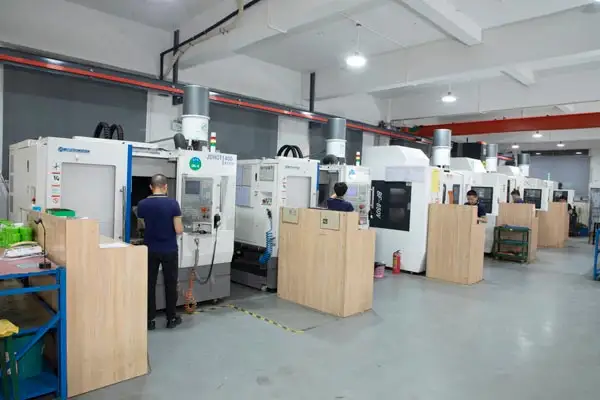
Modern machine shops leverage several distinct machining operations depending on part geometry, material hardness, and surface requirements:
- CNC Milling: The workpiece remains held in place while multi-point cutting tools rotate at high speeds to remove material along multiple axes. CNC milling excels at producing complex flat surfaces, slots, pockets, and multi-dimensional contours.
- CNC Turning: The cylindrical workpiece rotates at high RPM while a stationary single-point cutting tool feeds along the outer or inner diameter. CNC turning is the industry standard for producing round parts such as shafts, bushings, pins, and custom fittings.
- CNC Drilling: Rotating multi-flute drill bits plunge into the workpiece to create precise cylindrical holes for fasteners, tapping internal threads, or fluid passageways.
- Electrical Discharge Machining (EDM): Uses controlled electrical discharges (sparks) to erode conductive material, making it ideal for extremely hard alloys or deep, complex internal shapes that traditional rotary tools cannot reach.
Materials and Surface Finishes Supported
The CNC machining process works across a wide spectrum of industrial materials, providing flexibility for diverse engineering requirements:
- Metals: Aluminum (6061, 7075), Stainless Steel (304, 316, 17-4PH), Titanium, Brass, Copper, and Tool Steels.
- Engineering Plastics: POM (Delrin), ABS, PEEK, Polycarbonate, Nylon, and PTFE.
- Post-Processing Surface Finishes: As-machined, bead blasting, anodizing (Type II and Type III Hardcoat), passivation, powder coating, electropolishing, and custom plating to enhance corrosion resistance, surface hardness, and aesthetics.
Key Business Advantages of the CNC Machining Process
- Exceptional Precision: Standard production tolerances typically reach +/- 0.005 inches (+/- 0.125 mm), with precision micro-machining capable of achieving tolerances down to +/- 0.001 inches (+/- 0.025 mm).
- High Scalability: Seamlessly transitions from rapid prototyping to batch production without requiring custom permanent tooling or expensive die molds.
- Superior Mechanical Properties: Machining from extruded or forged solid stock maintains full material density, yield strength, and structural reliability compared to cast or printed components.
Frequently Asked Questions (FAQ)
What is the standard tolerance achieved by the CNC machining process? Commercial tolerances for the CNC machining process generally range between +/- 0.005 inches (+/- 0.125 mm) and +/- 0.001 inches (+/- 0.025 mm). Tighter tolerances can be maintained for critical features through precision tooling and temperature-controlled environments.
How does the CNC machining process differ from 3D printing? The CNC machining process is subtractive, carving parts out of solid material to yield maximum mechanical strength and surface quality. 3D printing is additive, layering material from the ground up, making it better suited for ultra-complex internal hollow structures or organic shapes.
What key factors drive the cost of the CNC machining process? Primary cost drivers include total machining runtime, material raw cost, geometric complexity, tight tolerance requirements, tool wear, fixture setups, and secondary surface finishing options.
Why is the CNC machining process preferred for high-precision components? Computer-guided toolpaths eliminate manual operator error, while high-rigidity CNC machine frames prevent tool deflection, ensuring tight dimensional accuracy across identical production units.


Request A Quote
We offer one-stop consulting services from design to mass production, ready to answer your questions anytime!


In This Article
Related Posts
How to Improve Precision Cutting Efficiency: A Full-Link Solution for Process Optimization and Intelligent Manufacturing
2026-09-18
CNC Prototype Machining Guide: Turning Concepts into Precision Parts
2026-09-15
How CNC Achieves Micron Accuracy
2026-09-08
Precision Machined Components Corrosion Control Guide
2026-09-03


