


 >
>


Methods for Mirror Polishing of Molds: A Technical Guide to High-Precision Surface Finishing
By hqt
Aug 19, 2026
Related Posts

How to Improve Precision Cutting Efficiency: A Full-Link Solution for Process Optimization and Intelligent Manufacturing
2026-09-18<

CNC Prototype Machining Guide: Turning Concepts into Precision Parts
2026-09-15<

How CNC Achieves Micron Accuracy
2026-09-08<

Precision Machined Components Corrosion Control Guide
2026-09-03<
Mirror polishing of molds is a critical finishing process in precision toolmaking, optical component manufacturing, and high-gloss plastic injection molding. Achieving a true mirror finish requires reducing surface roughness (Ra) to 0.05 µm or lower, effectively eliminating microscopic tool marks, scratches, and material defects. A high-quality polish prevents plastic parts from sticking during ejection, reduces friction, and delivers superior visual clarity on molded products.
Selecting the appropriate polishing technique depends on mold geometry, steel hardness, production volume, and required optical specifications.
Primary Methods for Mirror Polishing of Molds
1. Mechanical Mirror Polishing
Mechanical polishing remains the most versatile method for precision mold finishing. Technicians sequentially apply progressively finer abrasives—starting with oilstones and synthetic sandpapers, then advancing to diamond paste loaded onto felt bobs or wooden lap tools.
- Process Flow: The process transitions systematically from coarse grits (such as 320 or 600 mesh) up to micro-diamond compounds with grain sizes down to 1 µm or 0.5 µm.
- Primary Application: Best suited for core and cavity surfaces that demand precise dimensional control alongside high localized gloss.
- Operational Requirement: Alternating polishing directions by 45 to 90 degrees between grit changes prevents deep, unidirectional micro-scratches.
2. Ultrasonic Polishing
Ultrasonic polishing combines high-frequency micro-vibrations (typically 20 kHz to 30 kHz) with diamond abrasive slurry transmitted through a fitted tool tip.
- Technical Edge: High-frequency impacts enable rapid material removal with minimal manual fatigue and negligible thermal expansion.
- Primary Application: Ideal for hard-to-reach features, narrow ribs, deep slots, and small corner radii where conventional mechanical tools cannot fit.
3. Electropolishing (Electrochemical Polishing)
Electropolishing operates as a reverse electroplating process. The mold serves as the anode in an electrolyte bath; direct electric current selectively dissolves micro-peaks on the surface faster than the surrounding valleys.
- Technical Edge: Produces a smooth, reflective surface across complex contours simultaneously without inducing mechanical stress or work hardening.
- Primary Application: Highly effective for complex geometry where mechanical contact risks rounding off sharp features or critical tolerances.
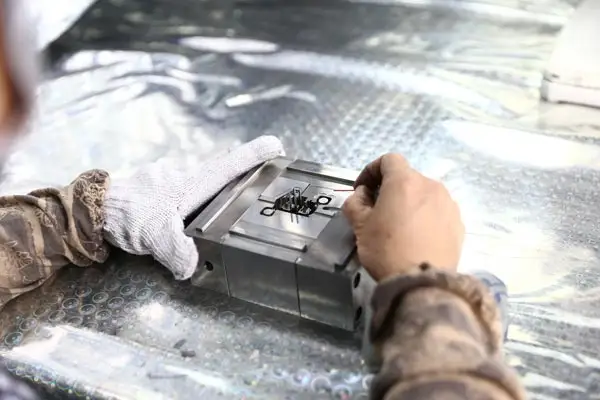
4. Chemical Polishing
Chemical polishing involves submersing the mold steel into a formulated chemical solution. The chemical reaction dissolves surface micro-protrusions through controlled passivation and etching.
- Technical Edge: Eliminates the need for complex tooling or power sources, allowing uniform surface treatment across intricate shapes.
- Primary Application: Commonly applied for preliminary smoothing or uniform glossing of complex internal channels.
5. Abrasive Flow Machining (Fluid Polishing)
Abrasive flow machining forces a flexible, viscous polymer medium embedded with abrasive grains back and forth through mold cavities under controlled hydraulic pressure.
- Technical Edge: Delivers uniform deburring and polishing along internal flow paths without damaging sharp parting lines.
- Primary Application: Essential for runner systems, extrusion dies, and internal channels requiring low fluid resistance.
Key Factors for Achieving Optical Mirror Quality
- Steel Quality: High-purity steel produced via Electroslag Remelting (ESR) or Vacuum Arc Remelting (VAR)—such as S136, NAK80, or Stavax—is essential. Non-metallic inclusions or voids in standard steel grades cause pitting during fine polishing.
- Heat Treatment: Steel must achieve a uniform hardness (typically HRC 52–58) to prevent uneven surface wear during abrasive stages.
- Contamination Control: Thorough ultrasonic cleaning between polishing steps is mandatory. A single rogue coarse grain introduced into a diamond paste stage will ruin a near-finished surface.
Frequently Asked Questions (FAQ)
What surface roughness defines a true mirror polish on a mold?
A standard mirror polish requires a surface roughness of Ra 0.05 µm or lower. For high-precision optical lenses or medical-grade components, standards typically demand Ra 0.01 µm to Ra 0.005 µm (SPI A-1 or A-0 finish grade).
How can operators prevent "orange peel" defects during mirror polishing?
Orange peel defects occur when excessive pressure, over-polishing, or localized heat causes micro-yielding in the steel matrix. To prevent this, limit polishing duration per step, maintain light contact pressure, and use high-purity, properly heat-treated mold steel.
Can all mold steels achieve an optical mirror finish?
No. Standard carbon steels containing gas pockets or soft spots cannot sustain an optical mirror polish. Achieving a mirror finish requires refined, vacuum-degassed steel grades specifically formulated for polishability.
Share on Social:


Request A Quote
We offer one-stop consulting services from design to mass production, ready to answer your questions anytime!


In This Article
Related Posts
How to Improve Precision Cutting Efficiency: A Full-Link Solution for Process Optimization and Intelligent Manufacturing
2026-09-18
CNC Prototype Machining Guide: Turning Concepts into Precision Parts
2026-09-15
How CNC Achieves Micron Accuracy
2026-09-08
Precision Machined Components Corrosion Control Guide
2026-09-03


