


 >


Titanium Medical Parts Machining: A Complete Guide to Precision, Materials, and Quality
By hqt
Oct 20, 2026
Related Posts

Stainless Steel Precision Parts: A Complete Guide to Stainless Steel Machining
2026-11-02<

What to Pay Attention to When Machining Tungsten Carbide
2026-10-30<

Stainless Steel Precision Parts: A Complete Guide for Modern Manufacturing
2026-10-27<

When Is a Hot Runner System Essential for Plastic Mold Manufacturing?
2026-10-22<
Titanium has become the material of reference for implantable and surgical medical devices, and titanium machining is the discipline that turns this exceptional metal into the precise, reliable components surgeons and patients depend on every day. From orthopedic implants to surgical instruments, medical titanium parts must satisfy two demands at once: extreme dimensional accuracy and strict regulatory compliance. This guide explains why titanium is used in medical manufacturing, how it is machined, what quality systems apply, and how to choose a machining partner you can trust.
Why Titanium Is the Material of Choice for Medical Devices
Medical device engineers choose titanium for reasons that go far beyond strength. Its combination of properties makes it uniquely suited to the human body:
- Biocompatibility. Titanium is biologically inert and does not trigger rejection reactions, making it ideal for long-term implantation.
- Osseointegration. Bone tissue bonds directly to titanium surfaces, which is essential for the long-term stability of hip, knee, and dental implants.
- Corrosion resistance. The naturally forming oxide layer protects titanium against bodily fluids, so components maintain their integrity for decades.
- High strength-to-weight ratio. Titanium provides the mechanical strength of steel at roughly half the weight, reducing implant mass and patient discomfort.
- MRI compatibility. Titanium is essentially non-magnetic, allowing patients with titanium implants to undergo MRI examinations safely.
These properties explain why titanium machining has become a core capability for medical contract manufacturers worldwide.
Common Titanium Grades Used in Medical Machining
Not all titanium is the same, and the choice of grade directly influences machining behavior, mechanical performance, and regulatory acceptance.
- Ti-6Al-4V ELI (ASTM F136 / ISO 5832-3). The workhorse of orthopedic implant machining. The "ELI" designation means extra-low interstitial elements, which improves fracture toughness and ductility. It is used for hip stems, knee components, spinal systems, and trauma plates.
- Commercially pure titanium, Grades 1–4 (ASTM F67). Pure titanium is softer and more corrosion-resistant, and is commonly machined for dental implants, bone screws, and surgical instruments where higher ductility is preferred.
- Ti-6Al-7Nb and specialty alloys. Alternative implant alloys with similar performance profiles, often chosen when avoiding vanadium is a design requirement.
- Nitinol (nickel-titanium). A shape-memory alloy used for stents and guidewires, requiring specialized processing and finishing.
For implantable medical titanium parts, the material must be supplied with full traceability — mill test certificates, chemical composition analysis, and mechanical property reports — because regulators and quality auditors will expect documented proof of material identity at every step.
The Main Challenges in Titanium Machining
Titanium is classified as a difficult-to-machine material, and understanding its behavior is the first step toward producing high-quality medical parts.
- Low thermal conductivity. Titanium conducts heat poorly, so cutting heat stays concentrated at the tool edge. This accelerates tool wear and can damage both the tool and the workpiece surface.
- Work hardening. Titanium work-hardens rapidly under cutting pressure, which means the next pass encounters a harder, more abrasive surface.
- Chip control. Titanium produces long, stringy chips that are difficult to break, increasing the risk of chip entanglement, built-up edge, and poor surface finish.
- Springback and deflection. Thin-walled implant components flex during cutting, making tight tolerances harder to hold.
- Burr formation. Sharp, tenacious burrs form along edges, requiring dedicated deburring and edge-conditioning steps before finishing.
None of these challenges is a barrier; they simply demand experience, the right tooling, and disciplined process control — which is exactly what professional titanium machining shops specialize in.
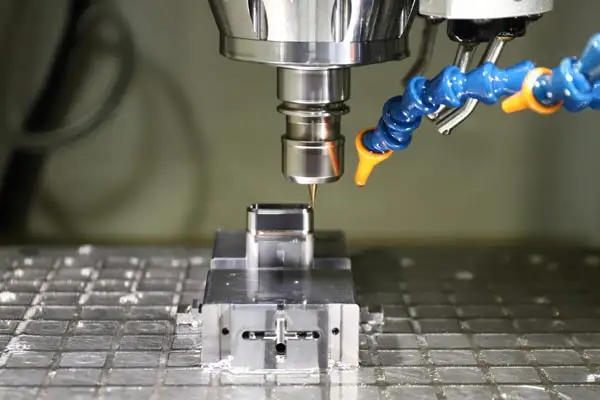
Core Machining Processes for Medical Titanium Parts
Medical titanium components are produced through a combination of subtractive processes selected according to geometry, batch size, and tolerance requirements.
CNC milling and turning. The foundation of most medical titanium machining. 5-axis CNC milling machines produce complex implant geometries in a single setup, while CNC turning handles cylindrical features such as screw heads, taper connections, and instrument shafts with high repeatability.
Swiss-type machining. For small, precise parts such as bone screws, dental abutments, and miniature instrument components, Swiss-type lathes provide exceptional accuracy and are ideally suited to long, slender titanium workpieces.
Wire and sinker EDM. Electrical discharge machining cuts titanium without mechanical force, which makes it invaluable for intricate internal features, sharp corners, and complex geometries that conventional cutting cannot reach.
Precision grinding. Grinding delivers the fine surface finishes and tight dimensional control required for bearing surfaces and mating interfaces in joint replacement systems.
Tooling and coolant strategy. Successful titanium machining relies on carbide or PCD tooling with specialized coatings, high-pressure coolant delivery to flush heat and chips away from the cut, and conservative cutting parameters that balance productivity with tool life and surface integrity.
Surface Finishing and Post-Processing
The surface of a medical titanium part is not cosmetic — it is functional, and in many cases regulatory. Common finishing steps include:
- Deburring and edge rounding. Removes machining burrs and smooths sharp edges that could damage soft tissue or compromise implant fit.
- Bead blasting. Creates a controlled micro-roughness that promotes osseointegration on implant surfaces.
- Electropolishing. Produces a smooth, clean, corrosion-resistant surface, commonly applied to surgical instruments and internal device components.
- Anodizing. Develops a thicker, colored oxide layer used for identification, corrosion protection, and aesthetic surface marking.
- Passivation. A chemical treatment that removes free iron and enhances the natural oxide layer, typically performed to standards such as ASTM A967.
- Laser marking. Permanent, legible marking of part numbers, lot numbers, and regulatory symbols for traceability.
Each finishing step must be qualified and documented, because surface condition directly affects biological response and is subject to scrutiny during regulatory audits.
Quality Control and Regulatory Compliance
Medical titanium machining operates under a quality framework far stricter than general manufacturing. A reliable partner will maintain:
- ISO 13485 certification, the international quality management standard for medical devices, often combined with ISO 9001.
- Compliance with FDA 21 CFR Part 820 for devices sold in the United States, and CE marking pathways for European markets.
- Full material traceability, linking every finished part back to its raw material lot and mill certificate.
- In-process and final inspection, using coordinate measuring machines, optical measurement systems, and surface roughness measurement to verify dimensional and finish requirements.
- Cleanroom capability for cleaning, packaging, and final assembly of implantable components.
- Complete device history records, including batch records, inspection results, and nonconformance documentation.
When you evaluate a machining partner, ask to see their quality system, audit reports, and examples of validation documentation. In medical manufacturing, documentation is part of the product.
Applications of Machined Titanium Medical Parts
The range of titanium medical components produced through precision machining is broad:
- Orthopedic implants: hip stems, acetabular shells, knee components, and shoulder systems.
- Spinal implants: interbody cages, pedicle screws, and rod systems.
- Trauma fixation: bone plates and screws for fracture repair.
- Dental implants and abutments: small, highly precise titanium parts with demanding surface requirements.
- Surgical instruments: forceps, retractors, and handheld tools that must survive repeated sterilization cycles.
- Cardiovascular components: device housings, catheter components, and structural elements where corrosion resistance is critical.
Across all these applications, the pattern is the same: demanding geometries, tight tolerances, and zero tolerance for quality failure.
How to Choose a Titanium Machining Partner
Selecting the right contract manufacturer determines whether your project stays on schedule and passes regulatory scrutiny. Look for:
- Proven medical experience with the specific alloy and part family you need.
- Validated certifications, including ISO 13485 and relevant FDA registration.
- Modern equipment, such as 5-axis machining centers, Swiss-type lathes, and EDM capacity.
- A robust quality system with documented inspection and traceability processes.
- Design-for-manufacturability support, because the best partners improve your design before the first chip is cut.
- Clear communication and confidentiality, including NDAs and protection of your intellectual property.
Conclusion
Titanium machining for medical applications is a demanding, highly regulated, and deeply rewarding discipline. The combination of titanium's biocompatibility and mechanical performance, matched with precision CNC processes and rigorous quality systems, is what enables the implants and instruments that improve millions of lives. Whether you are developing a new implant system or scaling an existing product line, partnering with a machining specialist who understands both titanium and medical quality requirements is the single most important decision you will make.
Frequently Asked Questions
Why is titanium considered difficult to machine? Titanium conducts heat poorly, work-hardens quickly, and produces tough chips that are hard to control. These factors cause rapid tool wear and demand specialized tooling, high-pressure coolant, and carefully optimized cutting parameters.
What is the best titanium grade for medical implants? Ti-6Al-4V ELI (ASTM F136 / ISO 5832-3) is the most widely used implant-grade alloy because of its excellent balance of strength, fatigue resistance, and biocompatibility. Commercially pure titanium (ASTM F67) is preferred for dental and certain surgical applications.
Can machined titanium medical parts be sterilized? Yes. Titanium withstands all standard sterilization methods, including autoclaving, ethylene oxide, and gamma radiation, without losing mechanical or surface integrity, which is why it is favored for reusable surgical instruments as well as implants.
What tolerances can be achieved in titanium medical machining? Precision shops routinely hold tolerances in the range of ±0.005 mm to ±0.025 mm on titanium features, depending on geometry and size. Final achievable tolerance depends on part design, machining strategy, and the stability of the workpiece during cutting.
Why does titanium machining cost more than stainless steel machining? Titanium is more expensive per kilogram, cuts slower due to its work-hardening and heat characteristics, and consumes tooling faster. The higher unit cost is offset by titanium's superior biocompatibility and long-term implant performance.
What certifications should a medical titanium machining supplier hold? At minimum, ISO 13485 for medical device quality management, ideally alongside ISO 9001, with FDA registration for US market supply. Suppliers of implantable components should also demonstrate material traceability and validated cleaning and packaging processes.
Share on Social:


Request A Quote
We offer one-stop consulting services from design to mass production, ready to answer your questions anytime!


In This Article
Related Posts
Stainless Steel Precision Parts: A Complete Guide to Stainless Steel Machining
2026-11-02
What to Pay Attention to When Machining Tungsten Carbide
2026-10-30
Stainless Steel Precision Parts: A Complete Guide for Modern Manufacturing
2026-10-27
When Is a Hot Runner System Essential for Plastic Mold Manufacturing?
2026-10-22


