


 >
>


Analysis Of The Key Differences Between Plastic Injection Molds And Silicone Molds
By hqt
May 30, 2026
Related Posts

How to Improve Precision Cutting Efficiency: A Full-Link Solution for Process Optimization and Intelligent Manufacturing
2026-09-18<

CNC Prototype Machining Guide: Turning Concepts into Precision Parts
2026-09-15<

How CNC Achieves Micron Accuracy
2026-09-08<

Precision Machined Components Corrosion Control Guide
2026-09-03<
In the field of mold manufacturing, plastic injection molds and silicone molds are two of the most widely used molding solutions. Although both are designed for product replication, they have essential differences in material properties, structural design, and application scenarios. The following analysis compares the two types from three key perspectives.
1. Fundamental Differences In Material Properties
Silicone molds use special mold silicone as the base material. They are usually produced by mixing silicone with epoxy curing agents according to a specific ratio, followed by curing at room temperature or under heated conditions. Silicone is a thermosetting material with advantages such as heat resistance, corrosion resistance, strong tear resistance, and high replication accuracy.
Due to the excellent flowability of silicone, silicone molds do not require a gate system design. Their manufacturing cost is significantly lower than plastic injection molds, making them highly economical for small-batch and high-precision replication applications.
Plastic injection molds, on the other hand, are integrated mold assemblies used for compression molding, injection molding, blow molding, and foam molding processes. They are also commonly known as injection molds or plastic molds.
Plastic materials are also classified as thermosetting materials, but they require injection molding processes to achieve final forming. Plastic injection molds are known as the “Mother of Industry”, as most new product developments involve plastic part mold manufacturing.
It is worth noting that to improve the overall performance of plastic products, various additives such as fillers, tackifiers, lubricants, thickeners, and stabilizers are usually added to polymers.
2. Differences In Mold Structure Design
The material of silicone molds is mold silicone, which typically consists of five components:
- Base silicone
- Coupling agent
- Catalyst
- Filler
- Preservative
In actual formulations, the base silicone, coupling agent, and filler are often combined into one component, while the catalyst remains as a separate component. This is the technical reason why mold silicone is classified as a two-component room-temperature curing silicone material.
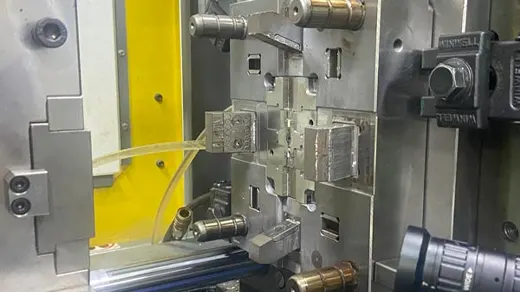
Plastic injection molds have a much more complex structure. Their core structure consists of two major systems:
1. Variable cavity system: Composed of the cavity base plate, cavity components, and cavity component backing plates.
2. Deformable core system: Composed of the core base plate, core components, core component backing plates, cavity separation components, and side cut component plates.
This multi-level structural design is developed to meet the requirements of precise plastic forming under high-temperature and high-pressure conditions.
3. Differences In Application Scenarios
Silicone materials can be divided into two main categories according to their chemical properties:
Solid Silicone
Mainly used for compression molding products, such as:
- Silicone covers
- Silicone kitchenware
- Silicone molds
- Silicone buttons
Liquid Silicone
Mainly used for extrusion molding products, such as:
- Silicone baby nipples
- Silicone tubes
Plastic injection molded products, however, cover almost every aspect of modern industry and daily life, including:
- Household appliances
- Instrument equipment
- Wires and cables
- Engineering machinery
- Electronic components
- Automotive parts
- Daily hardware products
It can be said that the application range of plastic injection molds is much broader than silicone molds. However, silicone molds remain irreplaceable in areas requiring high-precision replication and small-batch customization.
4. Mold Selection Recommendations
In actual projects, mold selection should be based on three key factors:
- Production volume
- Precision requirements
- Material compatibility
For products requiring large-scale production and complex structures, plastic injection molds are generally the preferred choice.
For small-batch production, high-precision parts, complex-shaped prototypes, or functional samples, silicone molds are more suitable.
The two mold types are not alternatives to each other, but rather complementary solutions for different manufacturing requirements.
FAQ
Share on Social:


Request A Quote
We offer one-stop consulting services from design to mass production, ready to answer your questions anytime!


In This Article
Related Posts
How to Improve Precision Cutting Efficiency: A Full-Link Solution for Process Optimization and Intelligent Manufacturing
2026-09-18
CNC Prototype Machining Guide: Turning Concepts into Precision Parts
2026-09-15
How CNC Achieves Micron Accuracy
2026-09-08
Precision Machined Components Corrosion Control Guide
2026-09-03


